

 EU public procurement guide
 EU public procurement guide
EU public procurementexplained for companies that bid.
How European government tenders are published, run and awarded, and where Flow, the Tendersight agent, takes on the reading and the forms.
A €2T+ public procurement market
Notices from 27 EU countries
TED and national portals, 28+ sources
One legal framework across the EU. A different portal and set of forms in every country.
EU directives set common procedures and principles, and each member state transposes them into national law. Flow reads each tender file as the authority published it, with its own requirements and forms.
What is EU public procurement?
The rules that govern how public bodies in the European Union buy works, supplies and services.
EU public procurement is the process by which public authorities, from ministries and regions to municipalities, hospitals and utilities, buy works, supplies and services from companies. Across the European Union this spending exceeds €2 trillion a year.
Above set value thresholds, contracts follow the EU procurement directives. They must be advertised across the EU, and companies from any member state can take part on equal terms. Below the thresholds, national rules decide how contracts are advertised and awarded.
Because each country transposes the directives into its own law, procedures and time limits share a common framework but differ in detail. For any specific contract, the tender documents and the national rules they refer to are the reference.
The principles behind every procedure.
They come from the EU Treaties and the directives, and explain much of what an authority can and cannot ask of tenderers.
Transparency
Contracts above the thresholds are advertised EU-wide, and the award criteria are published in advance.
Equal treatment
Every tenderer receives the same information and deadlines and is assessed against the same criteria.
Non-discrimination
An authority cannot favour a company because of its nationality or where it is based.
Proportionality
Selection criteria and requirements must be related and proportionate to the subject of the contract.
Mutual recognition
Equivalent certificates and qualifications from other member states must be accepted.
Competition
A procurement cannot be designed to narrow competition artificially or to favour particular companies.
How EU procurement works
Three directives set the framework. Each tender then follows one of a small set of procedures.
The framework rests on three directives adopted in 2014: Directive 2014/24/EU for public sector contracts, Directive 2014/25/EU for utilities in water, energy, transport and postal services, and Directive 2014/23/EU for concessions. They define the procedures, publication rules, exclusion grounds, and selection and award criteria that national laws build on.
Time limits run from the notice. In an open procedure, tenderers have at least 35 days from the date the notice was sent, and the directive allows shorter limits in defined cases, such as urgency or when a prior information notice was published.
Open procedure
- How it runs
- Any interested company submits a tender in response to the notice.
- Typical use
- Contracts where the authority can define its requirements in full from the start.
Restricted procedure
- How it runs
- Companies first request to participate. The authority checks the selection criteria and invites the selected candidates to tender.
- Typical use
- Contracts where the authority wants to limit the number of tenders it evaluates.
Competitive procedure with negotiation
- How it runs
- Selected candidates submit initial tenders, which the authority can negotiate before final tenders. Minimum requirements and award criteria are not negotiated.
- Typical use
- Needs that ready-made solutions cannot meet without adaptation, or that include design or innovation.
Competitive dialogue
- How it runs
- The authority discusses possible solutions with selected participants, then invites final tenders on the solutions identified.
- Typical use
- Complex contracts where the best solution is not known in advance.
Innovation partnership
- How it runs
- The authority selects partners to research and develop a product, service or works, and can then buy the result.
- Typical use
- Needs that no solution available on the market can meet.
Negotiated procedure without prior publication
- How it runs
- The authority negotiates directly with one or more companies without publishing a notice.
- Typical use
- Exceptional cases set out in the directive, such as extreme urgency or when only one company can perform the contract.
Where tenders are published in 27 EU countries
Contracts above the EU thresholds are advertised on TED. National and regional portals carry the rest.
Tenders Electronic Daily (TED) is the EU's official platform for notices above the thresholds, published in the Official Journal of the European Union. Since October 2023 these notices use eForms, a standard format that gives notices from every country a common structure.
The thresholds depend on who is buying and what: works have a much higher threshold than supplies and services, and central government, other contracting authorities and utilities each have their own values. The European Commission revises the amounts every two years, so check the current figures before relying on them.
Below the thresholds, notices usually appear only on national or regional portals, such as SEAP in Romania. Browse live tenders from all 27 member states, collected from TED and national portals.
- AT Austria
- BE Belgium
- BG Bulgaria
- HR Croatia
- CY Cyprus
- CZ Czech Republic
- DK Denmark
- EE Estonia
- FI Finland
- FR France
- DE Germany
- GR Greece
- HU Hungary
- IE Ireland
- IT Italy
- LV Latvia
- LT Lithuania
- LU Luxembourg
- MT Malta
- NL Netherlands
- PL Poland
- PT Portugal
- RO Romania
- SK Slovakia
- SI Slovenia
- ES Spain
- SE Sweden
Inside an EU tender file
Six terms that shape how an offer is prepared.
Lots
Large contracts are often divided into lots by type of work, product group or region, so smaller companies can bid for part of them. The authority can limit how many lots one tenderer may bid for or win, provided the notice says so.
Directive 2014/24/EU, Article 46
CPV codes
The Common Procurement Vocabulary classifies what is bought with numeric codes, from broad divisions such as 45000000 for construction work down to specific items. Every notice carries a main code, which makes CPV codes a precise way to search across countries and languages.
Regulation (EC) No 2195/2002
The ESPD
The European Single Procurement Document is a standard self-declaration on exclusion grounds and selection criteria. Authorities accept it as preliminary evidence, and usually ask for the supporting certificates only from the tenderer they intend to award the contract to.
Directive 2014/24/EU, Article 59
Award criteria
Contracts go to the most economically advantageous tender, judged on price, on cost such as life-cycle costing, or on the best price-quality ratio. The criteria and their weighting are stated in the tender documents.
Directive 2014/24/EU, Article 67
Framework agreements
A framework agreement sets the terms for contracts awarded during its term, which is generally limited to four years. Individual contracts are then awarded to the selected companies on the agreed terms or after a further round of competition between them.
Directive 2014/24/EU, Article 33
Award and standstill
Tenderers are told the award decision and the reasons for it. The contract cannot be signed before a standstill period ends, at least 10 days when the decision is sent electronically, which gives tenderers time to seek review.
Directive 2007/66/EC
Public procurement by sector
Works, IT, healthcare, supplies and services each bring their own documents and pricing.
From notice to offer, stage by stage.
What each stage asks of a tenderer, and the part Flow, the Tendersight agent, takes on.
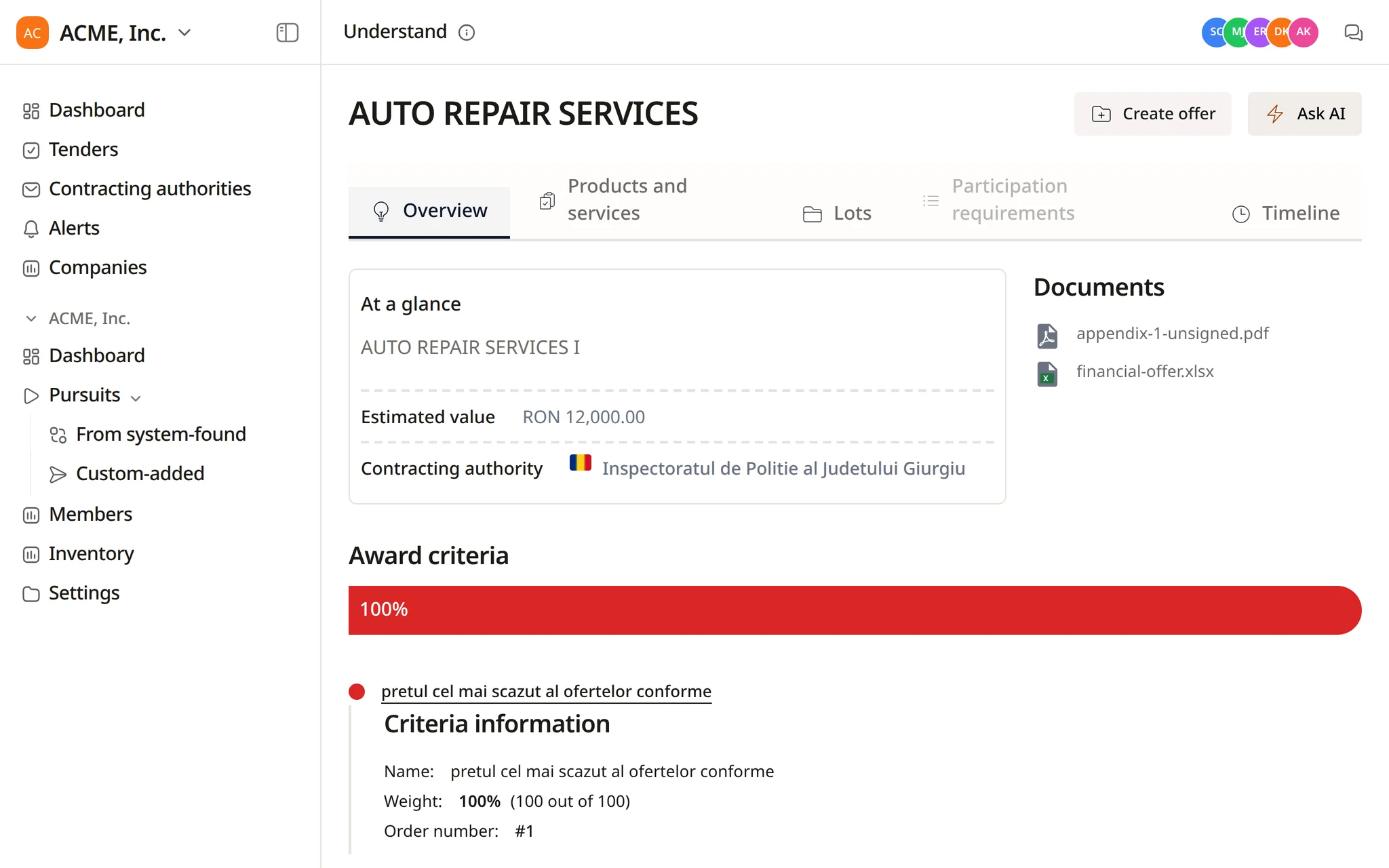
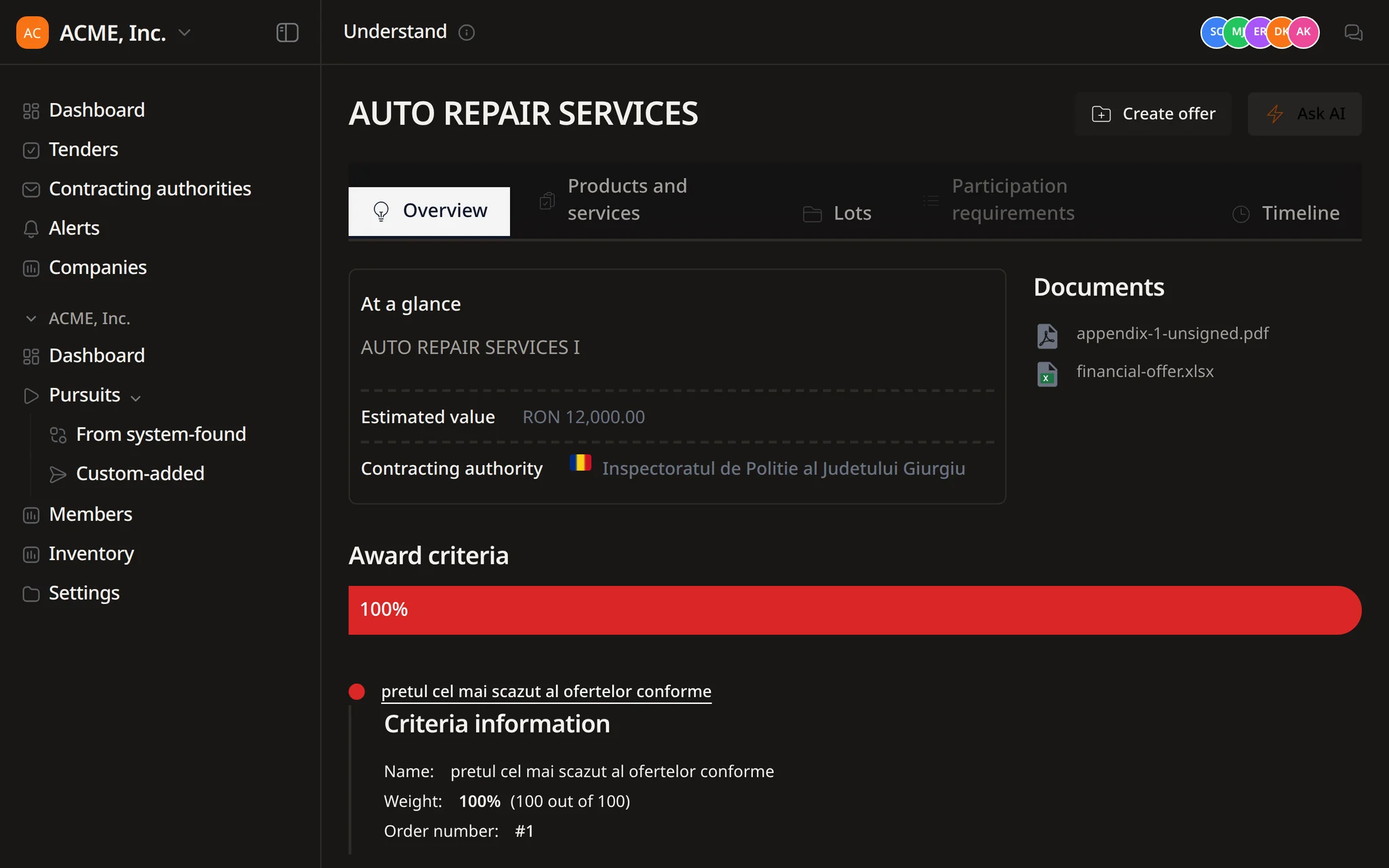
Above the thresholds, notices appear on TED and often on the national portal. Flow searches both by CPV code, country, value and deadline.
Authorities set minimum requirements on suitability, economic standing and technical ability. Flow checks each one against your documents and quotes the page it relies on.
Tenders are scored on price, cost or the best price-quality ratio, with weightings set in the tender documents. Flow extracts the criteria, so the offer answers what is scored.
Questions go to the authority before a set deadline, and the answers are shared with all tenderers. Flow drafts the questions and your team sends them.
The ESPD is submitted with the tender, often alongside national forms. Flow fills the authority's Word and Excel forms and saves filled copies for your review.
What to ask Flow about an EU tender.
Examples of requests from companies bidding for public contracts in other member states.
- Search
Find school catering tenders in Belgium, the Netherlands and Luxembourg with a deadline in the next 30 days.
- Rules
Open the Romanian tender we saved and summarise the national procurement rules that apply to it.
- Documents
Read the tender file for Lot 2 and list the selection criteria with the evidence each one asks for.
- Criteria
Extract the award criteria and their weighting, and show where our technical offer answers each one.
- Clarification
Draft clarification questions about the dietitian requirement in section 4.2.
- Schedule
Every Monday at 07:30, find new school catering notices in Belgium, the Netherlands and Luxembourg and summarise the relevant ones.
Bring a tender from another EU country.
In a demo we run a live notice through Flow: the search, the tender file analysis and the forms it asks for.
Related
Questions about EU public procurement
What is EU public procurement?
It is the way public authorities in the European Union buy works, supplies and services from companies. Above set thresholds, EU directives require contracts to be advertised across the EU and awarded under common procedures that give companies from every member state equal access.
What is TED (Tenders Electronic Daily)?
TED is the EU's official online platform for procurement notices above the EU thresholds, published in the Official Journal of the European Union in the eForms format. Tendersight collects TED notices together with notices from national portals.
What are the EU procurement thresholds?
They are contract values above which the EU directives apply and contracts must be advertised EU-wide. Separate thresholds exist for works, for supplies and services bought by central and by other authorities, for utilities and for concessions. The European Commission revises them every two years, so check the current amounts before relying on them.
Can non-EU companies bid on EU tenders?
Companies from countries covered by the WTO Government Procurement Agreement or by an EU trade agreement with procurement provisions have access to the contracts those agreements cover. Companies from other countries have no guaranteed right to take part, so check the notice and tender documents for the conditions of each procedure.
How do I find EU tenders for my industry?
Search by CPV code, the EU classification of what is being bought, combined with country, value and deadline. In Tendersight you can ask Flow to choose the CPV codes for your field, run the search across TED and national portals, and save it as an alert.
What is the ESPD?
The European Single Procurement Document is a standard self-declaration that a company is not in an exclusion situation and meets the selection criteria. Authorities accept it as preliminary evidence and ask for supporting documents later, usually from the tenderer they intend to award the contract to. When the ESPD is provided as a Word form, Flow can fill it and save a filled copy for your review.
Read your next EU tender with Flow.
Start free, search TED and national portals, and ask Flow to read the tender file.